Thessaloniki, +15.8°C
← All projects / Project

IPPog (CERN)

Flagship CERN partnership — seven years of Drupal engineering for global physics outreach
Platforms
scroll
Client IPPOG (CERN)
Scope PLATFORM
Role ENGINEER
Design BLIND STUDIO

The International Particle Physics Outreach Group (IPPOG) is a CERN-coordinated global collaboration of scientists, educators, and communication specialists working to make particle physics — the science of matter, energy, space, and time — accessible to students, teachers, and the wider public worldwide. Since 2019, Kukarika has been IPPOG’s technology partner, building and maintaining the digital ecosystem behind its global outreach: a custom Drupal platform engineered to CERN’s standards, an automated content pipeline that pulls records from the CERN Document Server into IPPOG’s Resource Database, a globally-mapped members directory, and a set of standalone reviewer tools that help curators prepare and organise bibliographic records destined for the CERN Document Server. Seven years in, the partnership continues — the platform has expanded alongside IPPOG’s mission, and every release still flows through the same engineering team that started it.

A CERN-coordinated outreach organisation that had to ingest bibliographic records from CERN's central Document Server into its own outreach catalogue, give a volunteer reviewer community proper tooling to organise resources, render a globally-distributed membership on a real-world map, and meet a security baseline that doesn't flex for anyone.

01

CDS → IPPOG ingestion

Educational resources are catalogued in CERN's central Document Server (CDS). IPPOG needed those records pulled into its own outreach catalogue automatically — parsed, mapped, and stored as first-class content in IPPOG's Resource Database, with attribution and editorial context preserved.

02

Reviewer tooling for CDS

Subject-matter reviewers needed standalone workspaces to organise, vet, and prepare bibliographic records that would eventually be entered into CDS — without working directly inside CERN's catalogue interface or hand-editing raw MARC XML.

03

Global membership map

IPPOG's members span dozens of countries — individual representatives, international experiments, laboratories, and associate members. Each had to appear in its right place on a single, navigable global map.

04

Editorial scale

Hundreds of contributors worldwide, each with their own permissions, content responsibilities, and language preferences — managed without a brittle role matrix.

05

Curation analytics

Coordinators needed real-time visibility into curation progress, reviewer activity, and resource throughput — not retroactive monthly spreadsheets.

06

Long-term scalability

The platform had to absorb new collaborations, new resource types, and new outreach campaigns across many years without rearchitecting from scratch.

07

CERN security baseline

Strict CERN security, reliability, and compliance requirements applied to every layer of the stack — hosting, deployment, code review, and dependency hygiene — with no exemptions.

A purpose-built Drupal platform engineered to CERN standards, anchored by the IPPOG Resource Database, an automated content pipeline pulling records from the CERN Document Server, a globally-rendered members map on OpenStreetMap, and a set of standalone reviewer tools that help curators prepare bibliographic records for CDS — all surfaced through interfaces designed for the volunteers who actually use them.

Custom Drupal Platform

  • Built from the ground up on Drupal, engineered to CERN's strict standards for security, reliability, and long-term maintainability
  • Editor-friendly structured content model — flexible enough for diverse collaborations, projects, events, and outreach activities
  • Multi-language interface for international contributors and audiences
  • Modular architecture that has absorbed seven years of feature growth without rearchitecting

IPPOG Resource Database

  • The heart of the platform — a curated, citation-grade catalogue of educational resources spanning videos, lesson plans, lectures, datasets, and exhibition material
  • Custom-built content types and taxonomies tailored to particle physics outreach
  • Faceted search, tagging, and editorial workflow purpose-built for the IPPOG editorial team
  • Structured for citation, search, and reuse — every record carries clean attribution and provenance

IPPOG Bridge from CDS

  • Custom Drupal modules ingest bibliographic records published on the CERN Document Server
  • Records are pulled in the MARC XML interchange format and mapped field-by-field into IPPOG's resource model — titles, authors, abstracts, types, taxonomies, and references all land in the right place
  • New CDS entries appear automatically as first-class content in IPPOG's Resource Database — searchable, taggable, and ready for editorial use
  • Attribution and provenance are preserved end to end — every IPPOG record traces cleanly back to its CDS origin
  • One-way ingestion only — CDS remains the authoritative bibliographic source; IPPOG's catalogue stays aligned without ever writing back

Standalone Reviewer Tools (RDB → CDS)

  • Two purpose-built standalone PHP tools that sit alongside the IPPOG site, dedicated to the resources flowing the other way — material that originates at IPPOG and needs to be prepared for entry into CDS
  • Reviewers load and read MARC XML records inside the tool, organise them, enrich metadata, and group them ready for CDS submission
  • Removes raw MARC editing from the reviewer workflow — curators work in a clean, structured interface instead of hand-crafting XML
  • The output is a clean, organised set of records that CERN can ingest into CDS through their standard catalogue process

Members Directory & Global Map

  • Comprehensive membership module covering individual representatives, international experiments, laboratories, and associate members
  • Globally-rendered interactive map built with the Leaflet module on OpenStreetMap tiles — every representative pinned on a real-world map with smooth zoom and pan
  • Member coordinates stored via the Geofield module (latitude / longitude per record) and surfaced through a dedicated Drupal View
  • Map legend filters by Member Group (taxonomy-driven), with the visible set updating in real time as filters are toggled
  • Click any pin to open a rich popup with the representative's role, affiliation, and contact context
  • Country-level overlay — members can be associated with whole countries, and those countries appear coloured on the map via per-country GeoJSON files, driven by standard ISO 3166-1 alpha-3 codes for unambiguous matching
  • Custom JS overlay logic + a Drupal form_alter render the taxonomy filters as checkboxes with their descriptions inline
  • Views Autosubmit module wires the filters to auto-apply the moment a category is selected — no submit button between the user and the result

In-Drupal Reviewer Workflow

  • Inside the IPPOG Drupal platform, reviewers and editors manage the Resource Database through curation queues, role-scoped editing, and approval workflow
  • Records that land via the CDS ingestion pipeline can be enriched, tagged, and surfaced in the catalogue without writing any raw bibliographic markup
  • Reviewer activity feeds the curation analytics dashboard directly — no separate reporting layer

Curation Statistics & Analytics

  • Dedicated analytics dashboard for IPPOG coordinators
  • Monthly curation activity captured easily, with automatic chart generation
  • At-a-glance views of resource throughput, reviewer activity, and progress against organisational goals
  • Replaces retroactive reporting with live operational visibility

CERN-Compliant Operations

  • Security, hosting, deployment, and update cadence aligned with CERN's organisational requirements
  • Continuous platform maintenance — version upgrades, dependency patching, and pro-active monitoring across the stack
  • Seven years of incident-free operation alongside ongoing feature delivery

A flagship outreach platform that turns the moving parts of global particle-physics communication — automated bibliographic ingestion, volunteer curation, geographic membership, editorial workflow — into one coherent, CERN-grade digital home.

  • Automated ingestion — new CDS records appear in IPPOG's Resource Database without manual re-keying, with attribution and provenance preserved end to end
  • Reviewer leverage — standalone tools let curators prepare CDS-bound records in a clean structured interface instead of hand-editing raw MARC XML
  • Centralisation — IPPOG's educational catalogue lives in one structured, searchable home rather than scattered across multiple systems
  • Global visibility — the interactive members map on OpenStreetMap turns IPPOG's worldwide presence into something contributors, partners, and audiences can actually see
  • Operational analytics — coordinators see curation progress in real time, replacing manual reporting with automatic dashboards
  • CERN compliance — every layer of the platform meets CERN's strict security and reliability baseline, without exemptions
  • Sustainability — seven years in, the partnership continues; the platform evolves alongside IPPOG's mission with the same engineering team that built it
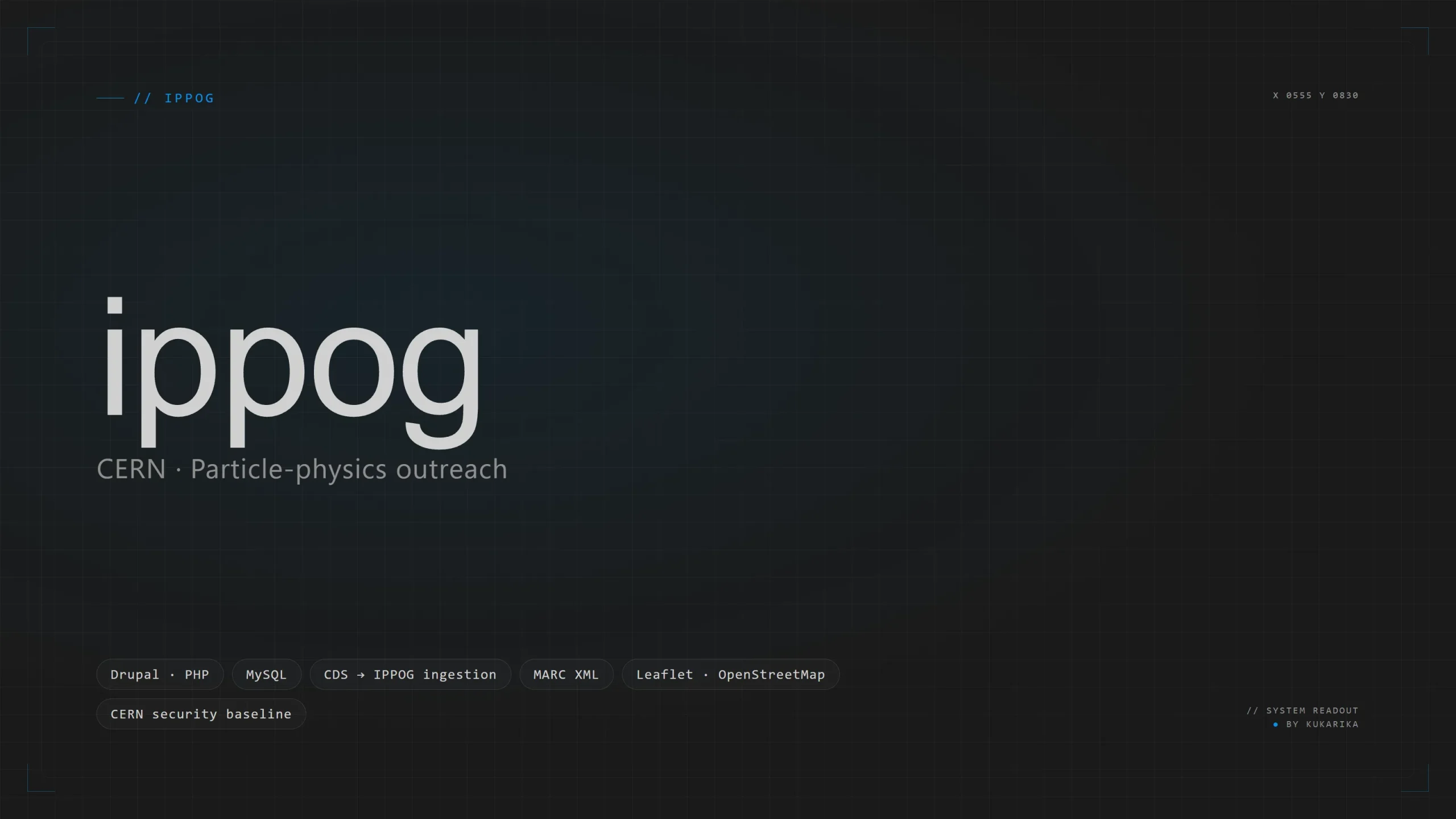
Drupal · Custom theme & modulesPHP · MySQLAutomated CDS → IPPOG record ingestionMARC XML bibliographic interchangeStandalone PHP reviewer tools (RDB → CDS preparation)Leaflet map on OpenStreetMap tilesGeofield (lat / lng) · per-country GeoJSON overlays · ISO 3166-1 alpha-3 mappingDrupal Views + Views Autosubmit for faceted filtersCustom form_alter for taxonomy-as-checkboxesIn-Drupal curation workflowCuration analytics dashboardMulti-language editorial interfaceCERN-compliant security baselineContinuous platform maintenance
// Outcome

Seven years on, the IPPOG platform is the operational home of one of CERN's most ambitious outreach programmes. The Resource Database stays current with the CERN Document Server because new CDS records flow into IPPOG automatically, attribution intact. Standalone reviewer tools let curators prepare the other side of that catalogue — records destined for CDS — in a clean structured interface instead of raw MARC XML.

The interactive global map turns dozens of countries' worth of contributors into a single coherent picture. And the partnership continues — every new collaboration, new feature, and new release still flows through the same engineering hands that have shaped this platform since 2019.

Need something similar? Let's talk.

Start a conversation